
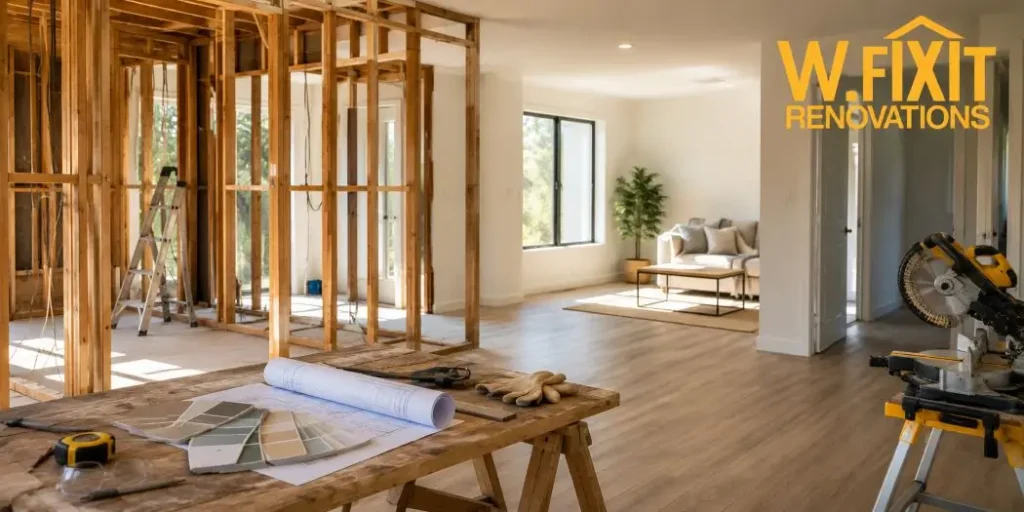
- How Do You Plan a Home Renovation? The Process, Step by Step
- Home Renovation Budget Planning: What Should You Actually Set Aside?
- Ready to Put a Real Number on Your Project?
- Renovation Timeline: How Long Does a Home Renovation Take?
- Do You Need Permits for a Renovation in Melbourne?
- How Do You Choose a Renovation Contractor in Melbourne?
- Preparing Your Home Before Renovation Work Begins
- Renovation Planning Across Melbourne's South-East
- Frequently Asked Questions
- Final Thoughts
- Talk to W.FixIt Before You Start
So you’ve decided to renovate. Congratulations, and also, brace yourself.
Home renovation planning in Melbourne can feel like assembling flat-pack furniture with no instructions. Everyone has an opinion. Every website quotes a different number. Your neighbour “did the whole kitchen for $12,000” and somehow that story never adds up.
This guide cuts through that noise. It walks you through exactly how to plan a home renovation, from your first sketch on a napkin to the day the tradies pack up and leave. Whether you’re in Berwick, Narre Warren, Cranbourne, or anywhere across Melbourne’s south-east, the same principles apply.
Let’s get into it.
How Do You Plan a Home Renovation? The Process, Step by Step
Every successful renovation follows a similar rhythm. Skip a step, and you usually pay for it later, sometimes literally.

Step 1: Define Your Scope
Start with a simple question: what actually needs to change?
Write down your must-haves separately from your nice-to-haves. A leaking shower base is a must-have fix. Heated towel rails are a nice-to-have. This split keeps your budget honest later on.
Homeowners who skip this step tend to expand their project mid-way through. That’s how a “quick bathroom refresh” turns into a full strip-out with moved plumbing.
Step 2: Set Your Budget
Once you know your scope, you can put real numbers against it. More on this below, because it deserves its own section.
Step 3: Build a Timeline
Renovations run on a sequence of trades. Get the order wrong, and you’ll pay someone to rip out work another tradesperson just finished.
Step 4: Get Quotes and Choose a Contractor
This is where planning turns into action. A good contractor doesn’t just execute your plan, they’ll flag problems in it before they become expensive surprises.
We’ll unpack each of these steps properly below.
Home Renovation Budget Planning: What Should You Actually Set Aside?
Let’s talk money, because vague answers help nobody.
The Housing Industry Association’s 2023 report, still widely cited as a benchmark, puts the average Australian renovation at around $26,000 for a mid-range project. This figure lines up with what many homeowners see in real quotes and ABS household expenditure data.
Melbourne-specific projects tend to sit at the higher end of national averages, largely due to labour costs and trade demand in metro areas. For context, Master Builders Australia puts a typical full bathroom renovation in Melbourne between $20,000 and $35,000, and premium finishes push that higher again.
Your total budget generally splits across four buckets:
| Category | Approx. % of Budget | What It Covers |
|---|---|---|
| Labour | 40–50% | Trades: plumbing, electrical, tiling, carpentry |
| Materials & Fixtures | 25–35% | Tiles, tapware, cabinetry, appliances |
| Permits & Compliance | 5–10% | Building permits, inspections, certifications |
| Contingency | 10–20% | Unplanned issues (subfloor damage, wiring faults) |
That contingency line isn’t optional padding. Older Melbourne homes, especially anything pre-war or built on a concrete slab, have a habit of hiding surprises behind walls. Budgeting for the unexpected is cheaper than discovering it without a buffer.
What a Proper Renovation Quote Should Include
A fixed-price quote should spell out labour, materials, permit costs, and a defined scope of work. If a quote looks unusually low, ask what’s missing. Skipped waterproofing or unlicensed labour brings the number down, and brings your risk up.
Ready to Put a Real Number on Your Project?
Guesswork budgets are how renovations go sideways. Get a free, no-obligation quote from W.FixIt and find out what your renovation actually costs, based on your home, not a national average.
Get your free, no-obligation quote from W.FixIt →Renovation Timeline: How Long Does a Home Renovation Take?
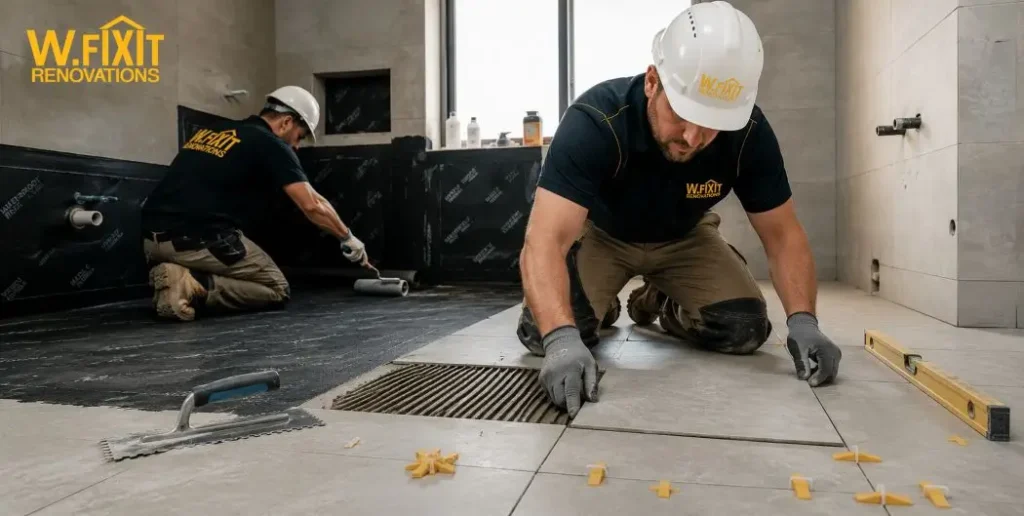
Timelines depend heavily on scope, but here’s a realistic guide for Melbourne projects.
| Stage | Trade Involved | Approx. Duration |
|---|---|---|
| Demolition & strip-out | Builder/labourer | 1–3 days |
| Plumbing & electrical rough-in | Licensed plumber/electrician | 2–4 days |
| Waterproofing | Licensed waterproofer | 1–2 days, plus cure time |
| Tiling | Tiler | 3–5 days |
| Cabinetry & fit-off | Carpenter, plumber, electrician | 3–7 days |
| Painting & finishing | Painter | 2–3 days |
A single bathroom typically wraps up in 2 to 4 weeks. Kitchens usually run longer, given the extra electrical and cabinetry work. Whole-home renovations or projects involving layout changes can stretch to several months, especially once permit approval time gets factored in.
What Order Should Renovation Work Be Completed In?
Trade order isn’t arbitrary. Demolition comes first, then rough-in plumbing and electrical, then waterproofing, then tiling, then cabinetry and fit-off, then painting.
Waterproofing has to fully cure before tiling starts. Rushing this step is one of the most common (and expensive) renovation mistakes, since it’s the difference between a bathroom that lasts decades and one that needs redoing in three years.
Do You Need Permits for a Renovation in Melbourne?
Often, yes, and it’s worth getting this right before work begins.
As of 1 July 2025, Victoria’s building regulator changed. The Building and Plumbing Commission (BPC) now oversees building and plumbing compliance state-wide, bringing together the former Victorian Building Authority (VBA), Domestic Building Dispute Resolution Victoria, and the domestic building insurance functions of the VMIA under one roof. If you’ve seen older articles reference the VBA, that’s the same regulatory function under a new name.
If you’re carrying out domestic building work valued at more than $10,000, it must be done by, or supervised by, a registered building practitioner. This applies whether you’re renovating a bathroom, kitchen, or doing structural work.
Wet areas carry an extra layer of compliance. Waterproofing in bathrooms and other wet areas needs to meet the AS 3740 standard, and it should be inspected before tiling starts. Skipping this step doesn’t just risk a failed inspection, it risks water damage that costs far more to fix than the waterproofing itself.
If you’re considering doing renovation work yourself, an owner-builder undertaking work valued over $16,000 needs a certificate of consent first.
The takeaway: always check that your builder or plumber holds current registration before signing anything. It takes two minutes and protects both your insurance and your investment.
How Do You Choose a Renovation Contractor in Melbourne?
This decision matters more than almost anything else on this list.

What to Check Before You Sign
- Registration: Confirm your builder or tradesperson is registered under the current BPC framework.
- Fixed-price quotes: Ask for a written quote with a defined scope, not a rough estimate.
- Insurance: Domestic Building Insurance should cover the project if something goes wrong.
- Local experience: A contractor who works regularly across Melbourne’s south-east understands local council requirements and typical home layouts in the area.
- Workmanship warranty: Get the warranty terms in writing before work starts.
Questions Worth Asking Any Contractor
- Can you provide references from recent, similar projects?
- What’s included in the quote, and what isn’t?
- Who handles the building permit, and how long will that take?
- What happens if hidden damage is found once demolition starts?
- What’s your typical timeline for a project this size?
A contractor who answers these clearly and without hesitation is usually one worth hiring. Vague answers are a red flag, no matter how competitive the price looks.
Preparing Your Home Before Renovation Work Begins
How to Minimise Disruption
Set up a temporary kitchen or bathroom space if the main one will be out of action. A kettle, microwave, and esky can carry a household further than people expect.
Protect the parts of your home that aren’t being renovated. Dust sheets and clear walkways go a long way toward keeping the rest of the house liveable.
Agree on a daily or weekly schedule with your contractor. Knowing roughly when trades will arrive each day makes the whole process far less chaotic.
Common Renovation Mistakes to Avoid
- Skipping the contingency budget, then panicking when something comes up
- Starting work before permits are confirmed
- Changing scope halfway through (this is where budgets quietly blow out)
- Choosing a contractor on price alone, without checking registration or insurance
Most renovation stress traces back to one of these four mistakes. Avoid them, and the process runs a lot smoother than the horror stories suggest.
Renovation Planning Across Melbourne’s South-East
Renovation costs and timelines shift depending on where you live. Home age, subfloor conditions, access for trades, and local trade availability all play a part.
W.FixIt renovates homes across Berwick, Narre Warren, Hampton Park, Hallam, Cranbourne, Dandenong, Keysborough, Springvale, Clayton, Oakleigh, Bentleigh, and Caulfield. If you’re after suburb-specific pricing, our Bathroom Renovation Cost by Suburb guide breaks down real numbers for the local area.
Frequently Asked Questions
Start by defining your scope, then set a realistic budget, build a timeline based on trade sequencing, and get quotes from registered contractors before committing to anything.
Costs vary by project type and scope, but the Housing Industry Association’s benchmark sits around $26,000 for a mid-range renovation nationally, with Melbourne bathroom projects typically running $20,000 to $35,000 according to Master Builders Australia. Always add a 10 to 20 percent contingency on top.
A single bathroom typically takes 2 to 4 weeks. Kitchens run longer due to extra electrical and cabinetry work, and whole-home renovations can extend to several months, especially with permit approvals involved.
Yes, in most cases. Domestic building work over $10,000 needs a registered building practitioner, and the Building and Plumbing Commission (BPC), formerly the VBA, oversees compliance across Victoria.
Check their registration status, ask for a fixed-price quote with a clear scope, confirm insurance coverage, and look for local experience in your specific suburb.
Final Thoughts
Home renovation planning in Melbourne doesn’t need to feel like guesswork. Get the scope right, budget honestly (contingency included), understand the trade sequence, confirm your permits, and choose a contractor who can answer your questions without dodging them.
Do those five things properly, and the rest of the project tends to take care of itself.
Talk to W.FixIt Before You Start
Every renovation is different, and a generic guide can only take you so far. Contact W.FixIt today for a free consultation on your Melbourne home renovation, or browse our renovation guides and resources for more suburb-specific advice.
Contact W.FixIt →