
- What Is a Bathroom Renovation?
- Why Renovate Your Bathroom?
- Types of Bathroom Renovations
- Bathroom Renovation Costs in Melbourne
- Ready to Stop Guessing and Start Renovating?
- Planning Your Bathroom Layout
- Choosing Materials and Fixtures
- Small Bathroom Renovation Ideas
- Bathroom Renovation Timeline
- Bathroom Renovation by Melbourne Suburb
- Common Bathroom Renovation Mistakes to Avoid
- Do You Need Council or Building Approval?
- Choosing the Right Bathroom Renovator
- Let's Turn This Guide Into Your Bathroom
- Frequently Asked Questions
- Final Thoughts
A bathroom renovation sits in a strange spot on most people’s to-do lists. You know you need one. You’ve known for years, honestly. But between the horror stories about blown budgets and the mystery of what actually happens behind those tiles, most homeowners keep putting it off.
Here’s the good news: a bathroom renovation doesn’t have to be a gamble. It just needs a plan.
This guide walks Melbourne homeowners through everything that matters — real costs, realistic timelines, the permit rules that actually apply to you, and the mistakes that turn a simple reno into a six-month saga. We’ll keep the jargon low and the honesty high.
Whether you’re in Hampton Park, Berwick, Cranbourne, or anywhere across Melbourne’s south-east, the fundamentals of a good bathroom renovation stay the same. Let’s get into it.
What Is a Bathroom Renovation?
Not every bathroom project is created equal, and the terms get thrown around loosely. A “bathroom renovation” can mean three very different jobs.
Cosmetic refresh. New paint, updated tapware, a fresh mirror. The bones of the room stay untouched.
Mid-range renovation. A full strip-out with new tiling, a new vanity, and a shower replacement, usually without moving plumbing.
Full renovation. Structural work, waterproofing redone from scratch, and sometimes a completely new layout with plumbing relocated.
Knowing which category you’re in matters more than most people realise. It determines your budget, your timeline, and whether you’ll need a permit at all — more on that shortly.
Why Renovate Your Bathroom?
Increasing Property Value
A dated bathroom is one of the first things buyers mentally deduct from their offer. Industry data suggests a well-executed bathroom renovation in Melbourne typically returns 60–80% of its cost in added property value, particularly in the inner and eastern suburbs where buyer expectations run high (Master Builders Australia benchmark).
That’s not a guaranteed profit — renovations are still an investment in comfort first. But it’s a strong argument against ignoring the problem.
Improving Functionality and Accessibility
Families change. Bodies change. A bathroom designed for a share-house in 2005 rarely suits a growing family or ageing parents in 2026. Wider doorways, grab-rail-ready walls, and step-free showers make a real difference for long-term liveability.
Fixing Water Damage or Ageing Infrastructure
Sometimes a renovation isn’t optional. Mould, persistent leaks, or plumbing that predates most of your neighbours’ houses are signs the bathroom is actively working against you. Left alone, these issues get worse — and more expensive — every year.
Types of Bathroom Renovations
- Ensuite renovation — smaller footprint, typically 20–30% cheaper than a main bathroom due to reduced scale.
- Small bathroom renovation — space-smart layouts and storage solutions for compact rooms.
- Luxury bathroom renovation — freestanding baths, custom joinery, and premium stone finishes.
- Full bathroom remodel — a genuine layout change, moving fixtures to reimagine how the room works.
Each type carries a different budget and a different set of decisions. There’s no wrong choice here — only the choice that matches your home, your household, and your bank account.
Bathroom Renovation Costs in Melbourne
This is the question everyone actually wants answered, so let’s not dance around it.
Cost estimates vary across the industry, but a consistent pattern shows up. A cosmetic refresh generally starts from around $8,000. A standard mid-range renovation — the most common choice for Melbourne homeowners — typically lands between $20,000 and $35,000, a range published as an industry benchmark by Master Builders Australia (source). The Housing Industry Association has also cited a national average bathroom renovation cost in the mid-$20,000s (HIA). Premium renovations with custom joinery and high-end fixtures can exceed $40,000–$50,000, particularly in Melbourne’s inner and eastern suburbs.
What Drives the Price Up or Down
- Waterproofing — non-negotiable and one of the most underestimated line items in any quote.
- Tiling choice — large-format tiles are generally cheaper to lay per square metre than mosaics.
- Plumbing relocation — keeping your toilet, shower, and vanity in their existing positions is the single biggest cost-saver available to you.
- Fixture quality — budget versus premium tapware and vanities can shift the fixtures budget significantly.
- Access — apartment renovations sometimes involve lift bookings and stricter working hours, which adds cost.
A smaller bathroom doesn’t automatically mean a smaller bill. Waterproofing, licensed plumbing, and compliance requirements apply regardless of square metreage, so compact bathrooms still carry a meaningful base cost.
Ready to Stop Guessing and Start Renovating?
Every bathroom is different, and averages only get you so far. The fastest way to know your real number is a proper on-site assessment from a licensed local team.
Get your free, no-obligation quote from W.FixIt →Planning Your Bathroom Layout
Good layout planning is where money gets saved or wasted — often before a single tile is laid.
Working With Your Existing Plumbing
Every fixture you relocate adds cost. Keeping the toilet, shower, and vanity roughly where they already are is the most reliable way to control your budget without cutting corners on quality.
Popular Layout Configurations
Walk-in showers remain the most requested feature in Melbourne bathrooms right now, largely because they read as modern and work well for households of any age. Freestanding baths, wall-hung vanities, and wet-room-style layouts are close behind.
Small-Space Layout Tips
In compact bathrooms, every decision compounds. Sliding doors instead of hinged ones, mirrored cabinetry for hidden storage, and large-format tiles that reduce visual grout lines all help a small room feel bigger than it is.
Choosing Materials and Fixtures
Tiling and Waterproofing
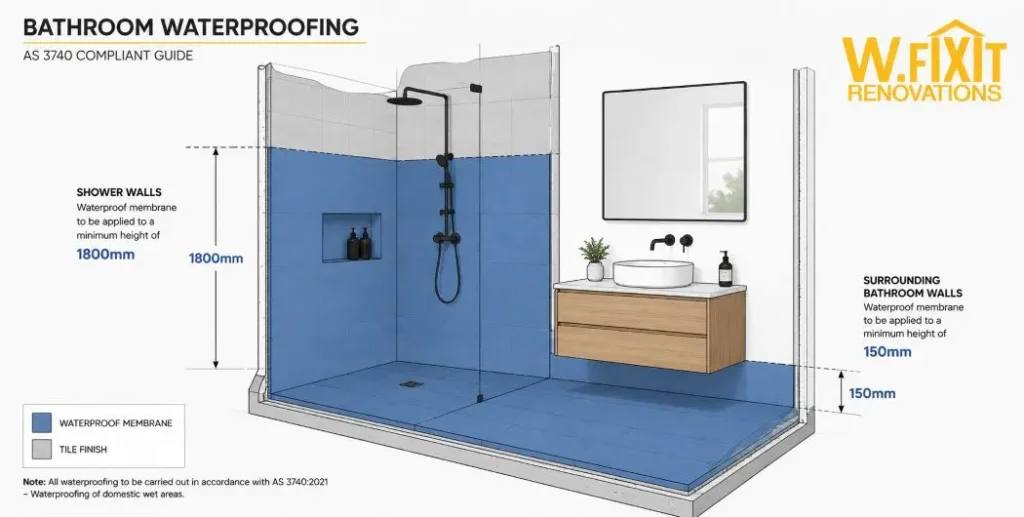
Waterproofing is where Melbourne building standards get genuinely strict, and for good reason. Under AS 3740:2021, the Australian Standard for waterproofing domestic wet areas, shower walls must be waterproofed to a minimum of 1,800mm, and general bathroom walls to at least 150mm (AS 3740:2021, referenced via NCC). If your bathroom floor is timber, or the bathroom sits above ground level, the entire floor requires waterproofing — not just the shower recess.
This isn’t red tape for the sake of it. Poor waterproofing is consistently one of the most common building complaints raised with the Victorian Building Authority, and rectifying a failed membrane after the fact costs far more than doing it properly the first time.
Always ask for a compliance certificate once waterproofing is complete. It’s your proof that the work meets the standard, and it protects you if you ever sell the property.
Vanity, Toilet, and Storage Solutions
Wall-hung vanities and toilets are popular for a reason — they make cleaning easier and create the illusion of more floor space, which matters enormously in a smaller room.
Lighting Design
Layered lighting (task lighting near the mirror, ambient lighting elsewhere) beats a single central downlight every time. It’s a small line item with an outsized impact on how finished the room feels.
Shower, Bath, and Tapware Selection
Under Victorian regulations, new fixtures must meet the Water Efficiency Labelling and Standards (WELS) scheme, generally at least a 3-star rating for taps, showers, and toilets. Beyond compliance, this also keeps your water bill in check for years to come.
Small Bathroom Renovation Ideas
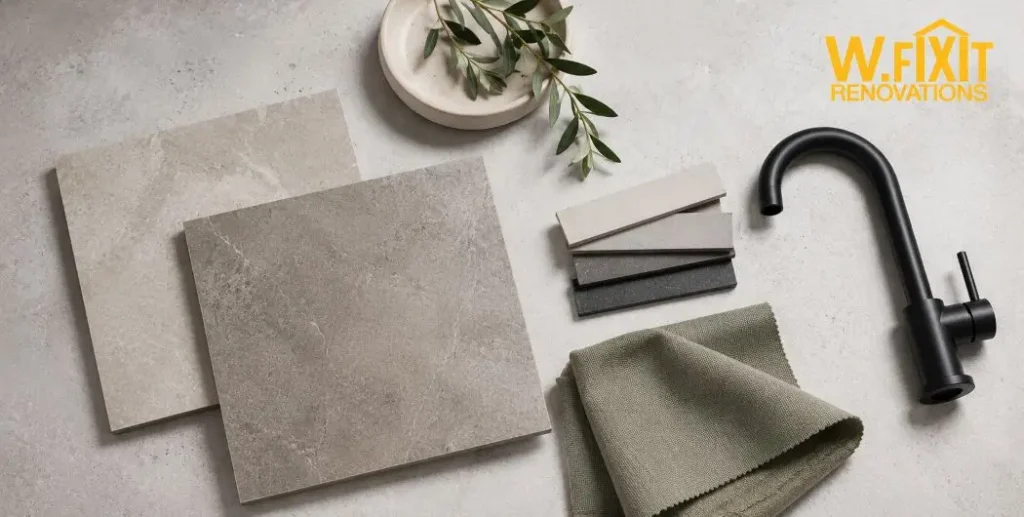
Small doesn’t mean limited. Pale, cohesive colour palettes visually expand a room. Recessed niches instead of bulky shelving keep sightlines clean. Frameless glass shower screens remove visual barriers that make a compact room feel boxed in.
The goal isn’t to cram in every feature from a magazine spread — it’s to choose fewer things and let them do more work.
Bathroom Renovation Timeline
Patience isn’t most people’s strong suit during a renovation, so here’s what to actually expect.
| Stage | What Happens |
|---|---|
| Planning & Design | Layout, material selection, quoting |
| Demolition | Strip-out of old fixtures, tiles, and fittings |
| Rough-in | Plumbing and electrical repositioning |
| Waterproofing | Membrane application and curing time |
| Tiling | Floor and wall tiling |
| Fit-off | Fixtures installed, final inspection |
Most Melbourne bathroom renovations run 2 to 6 weeks from demolition to completion, depending on scope. Cosmetic refreshes sit at the shorter end. Full renovations with plumbing relocation or structural work sit at the longer end, and delays are common when fixtures are on backorder or unexpected issues surface mid-strip-out.
Waterproofing curing time is a big reason renovations can’t simply be rushed. It’s not a step you want a contractor skipping to hit a deadline.
Bathroom Renovation by Melbourne Suburb
Renovation costs and trade availability can shift slightly depending on where you live, largely due to access, property age, and local demand. Homeowners across Hampton Park, Hallam, Narre Warren, Berwick, Cranbourne, Dandenong, Lynbrook, Keysborough, Springvale, Clayton, Bentleigh, Oakleigh, and Caulfield face broadly similar considerations: older housing stock in some pockets, growing demand for modern layouts, and a strong preference for licensed, local tradespeople who know the area.
If you’re comparing quotes across suburbs, make sure you’re comparing like-for-like scope. A cheaper quote that excludes waterproofing certification isn’t actually cheaper.
Common Bathroom Renovation Mistakes to Avoid
- Skipping the permit check. Not every renovation needs one, but assuming you’re exempt without checking can cost tens of thousands in rectification work later.
- Underestimating waterproofing. It’s the single most expensive mistake to fix after tiling is complete.
- Choosing the cheapest quote blindly. Compare inclusions, not just totals.
- Poor ventilation planning. Bathrooms without windows legally require mechanical exhaust ventilation that vents outside, not into the ceiling cavity.
- No contingency budget. A buffer of 10–15% covers the unexpected issues that show up once demolition starts.
None of these mistakes are exotic. They’re the same five issues that come up again and again, which is exactly why they’re worth taking seriously.
Do You Need Council or Building Approval?
Short answer: sometimes, and it depends on scope rather than square metreage.
In Victoria, most cosmetic renovations — repainting, like-for-like fixture swaps, re-grouting — don’t require a building permit (DWS Building Co.). But a building permit is generally required when your renovation involves structural changes, relocated plumbing, or converting a non-wet room into a bathroom. Permits in Victoria are issued by registered building surveyors under rules set by the Victorian Building Authority (VBA), not by your local council directly for most building work.
If your home sits within a heritage overlay, additional planning approval may apply even for otherwise straightforward internal work — worth checking with your council early.
One more detail worth knowing: renovation contracts over $16,000 in Victoria require Domestic Building Insurance (DBI), which protects you if your builder becomes insolvent or is unable to complete the job (Skilled Tradies Melbourne). It’s worth asking about upfront, not after signing.
Choosing the Right Bathroom Renovator
Licensing and Insurance
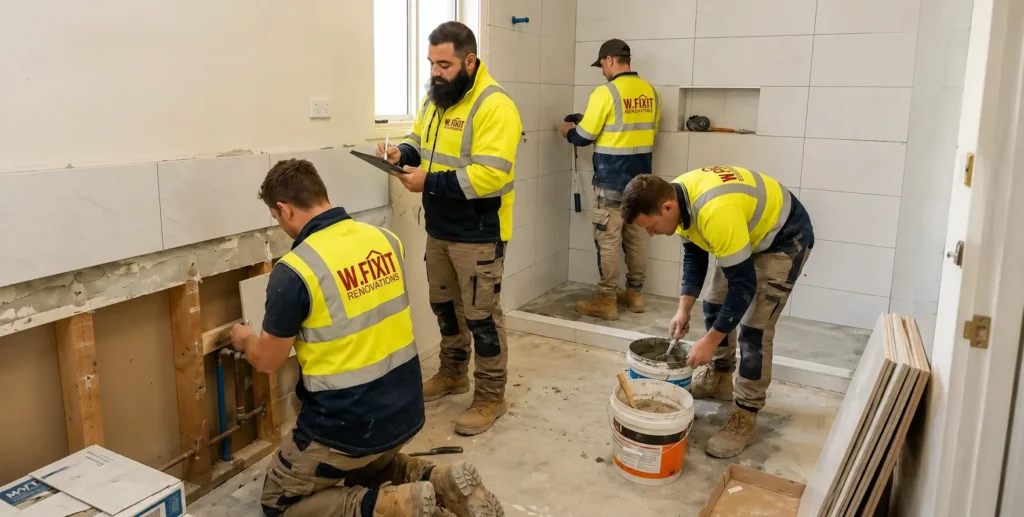
Ask for VBA registration details, proof of public liability insurance, and a compliance certificate from a previous job. If a renovator hesitates on any of these, treat that hesitation as your answer.
Workmanship Warranty
Under the Domestic Building Contracts Act, Victorian renovations carry implied warranties covering workmanship and materials. A renovator confident in their work won’t dodge questions about warranty length or what it covers.
Reading Reviews and Past Projects
Photos are easy to stage. Ask to see completed projects in person if possible, or speak to a past client directly.
Getting an Accurate, Itemised Quote
A trustworthy bathroom renovation quote breaks down labour, materials, waterproofing, and compliance certification separately. If a quote is just one number with no breakdown, ask for more detail before signing anything.
Whether you’re after affordable bathroom renovation options or a fully custom bathroom renovation, the process starts the same way — with a renovator who explains their pricing instead of just stating it.
Let’s Turn This Guide Into Your Bathroom
Reading about renovations is one thing. Actually starting one is another. If you’re ready to move from research to reality, W.FixIt’s licensed local team services Hampton Park, Berwick, Narre Warren, Cranbourne, Dandenong, and the wider south-east Melbourne area.
Book your free consultation with W.FixIt today →
Prefer to browse more renovation guides first? Head over to the W.FixIt blog or explore our bathroom renovation services page.
Frequently Asked Questions
Costs generally range from around $8,000 for a cosmetic refresh to $20,000–$35,000 for a standard mid-range renovation, based on industry benchmarks from Master Builders Australia and the HIA. Premium renovations can exceed $40,000, particularly in Melbourne’s inner and eastern suburbs.
Most Melbourne bathroom renovations take 2 to 6 weeks from demolition to completion. Cosmetic refreshes sit at the shorter end; full renovations with plumbing relocation take longer.
Most cosmetic renovations don’t need a building permit. Structural changes, plumbing relocation, or converting a room into a new wet area generally do, and permits are issued through a registered building surveyor under Victorian Building Authority rules.
Yes. Small bathrooms benefit from large-format tiles, wall-hung fixtures, and pale colour palettes that create the impression of more space, even when the footprint stays the same.
Check VBA registration, ask for proof of public liability insurance, request an itemised quote, and confirm what warranty applies to the workmanship. A renovator who answers these questions clearly is usually one worth trusting.
Final Thoughts
A bathroom renovation isn’t just about tiles and tapware. It’s about waterproofing done properly, a layout that suits how you actually live, and a renovator who treats compliance as a standard, not an inconvenience.
Get those three things right, and the rest — the colour palette, the fixtures, the finishing touches — becomes the fun part.
If you’re ready to start planning your bathroom renovation in Melbourne’s south-east, W.FixIt is a phone call or a click away. Get your free quote today →